A national project
His existing activism gives us a baseline of commitment to Jewish national aspirations, rather than a politically uncommitted traveler. 1
HISTORY OF IDEAS · UNIT 01
Avraham Stern in Florence, 1933–1934.
What changes when a traveler carries his
convictions across a border?
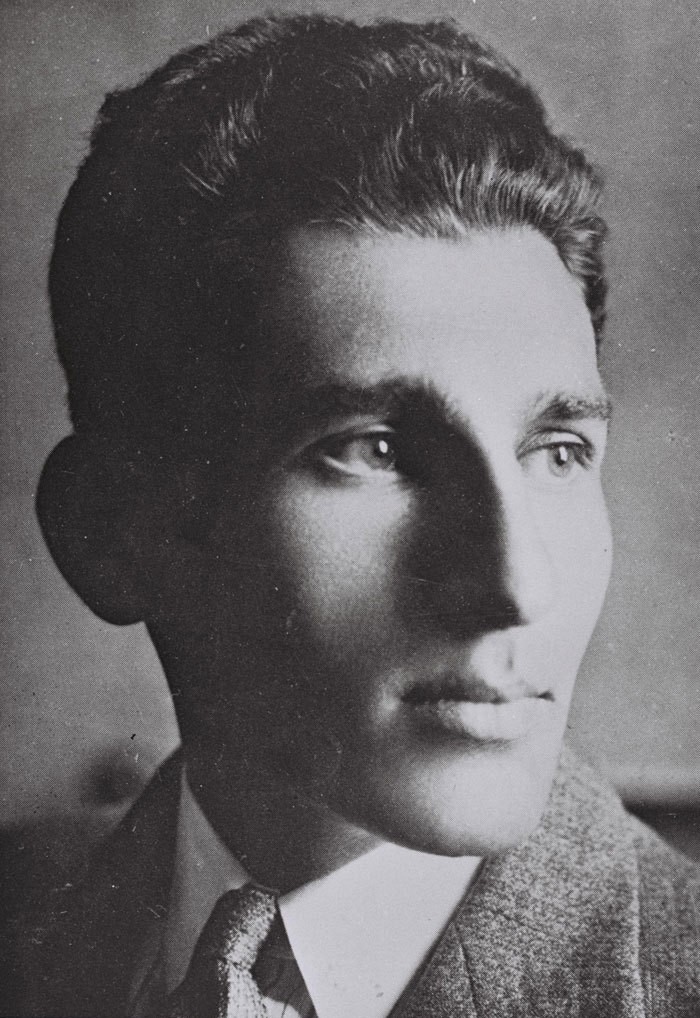 FIG. 01 / THE TRAVELER
Our interpretation: Florence helped redirect Stern from scholarship toward full-time underground activity, while largely reinforcing an existing commitment to Jewish sovereignty. His later wartime radicalization involved further decisions and pressures; it cannot be explained by Florence alone. 1346
01 / BEFORE THE JOURNEY
BEFORE 1933A student of the classical world.
A participant in a nationalist struggle.
Stern studied at the Hebrew University and was already involved in Jewish underground organizations: the Haganah from 1929 and the group that became the Irgun from 1931. Political commitment preceded his studies in Italy. 1
This starting point matters. A later change in occupation does not, by itself, prove the invention of a new worldview.
THE STARTING WORLDVIEW
His existing activism gives us a baseline of commitment to Jewish national aspirations, rather than a politically uncommitted traveler. 1
His move to Florence opened a path in advanced classical studies. Education was a real possibility alongside political involvement. 4
Enrollment supports an intention to study. It does not establish what he privately expected from Italian politics or predict his later choices. 2
02 / DURING THE JOURNEY
FLORENCE · 1933–1934Follow the evidence from an academic opportunity to a personal letter and a consequential meeting. Select an encounter to examine what it can tell us.
THE ENCOUNTER
The University of Florence file, published by historian Vincenzo Pinto, records Stern’s enrollment on 7 February 1934. Its certificates and course records document his academic background. 2
The academic route makes his later departure a meaningful choice. The record supports a change in life direction, but says little about any conversion to Fascism.
Evidence limit: An administrative record establishes enrollment, not an inner political transformation.
Examine the source record ↗THE ENCOUNTER
In an April 1934 letter to Mordechai Morzyński, Stern described Italy favorably while treating Palestine as the place of genuine national freedom. 3
“everywhere we feel like guests at most, yet in Palestine we are landlords”
Stern, April 1934 · English translation in Kedem, lot 179
Distance sharpened an existing attachment. His language of ownership also invites a question: whose belonging does this national vision leave unspoken?
Evidence limit: A private letter gives one situated response, not a full account of Italian society.
Read the letter’s significance ↗THE ENCOUNTER
The Lehi Heritage Association dates Avraham Tehomi’s recruiting visit to May 1934. Its account says Stern accepted underground work involving arms procurement in Poland and abandoned his academic career. 4
This is the clearest mechanism linking the journey to a changed life: a personal encounter supplied a concrete role. It activated an existing commitment.
Evidence limit: This is a retrospective commemorative account. Its precise dating and interpretation deserve corroboration.
Assess the source’s perspective ↗The question to carry forwardDo new actions necessarily mean new beliefs?
↓03 / AFTER THE JOURNEY
1934–1941Florence was a turning point in vocation. The later break in political strategy unfolded across a changing European and imperial context.
Stern’s subsequent work in Poland included organizing training and obtaining arms. Travel now served underground politics rather than academic advancement. 9
The change is observable in his role; the core national objective persisted.
The 1939 White Paper restricted Jewish immigration. During the war, Raziel prioritized cooperation with Britain against Hitler; Stern insisted on continuing the struggle against British rule. Their dispute contributed to the 1940 split. 76
A shared crisis produced different responses. Stern’s decision was not inevitable.
A proposal associated with Stern’s organization offered wartime cooperation with Nazi Germany in exchange for support for a Jewish state. It is evidence of an attempted alliance, not a completed one. 810
This strategic and moral radicalization cannot simply be dated back to Florence.
03 / AFTER · COMPARING THE EVIDENCE
CHANGE & CONTINUITY| Dimension | Before / in Florence | Later outcome | Our judgement |
|---|---|---|---|
| Life direction | Scholarship alongside activism | Underground organization as his main work 4 | Substantial change |
| National belonging | Palestine as his national home | Jewish sovereignty remained the goal 38 | Strong continuity |
| Political alignment | Work within the Irgun | Break with its wartime strategy in 1940 6 | Later rupture |
| Cause of change | Study, reflection and recruitment | Further travel, imperial policy and war | Multiple causes |
THE EVIDENCE ROOM
READ · INTERPRET · QUESTIONA source is evidence for a particular claim. It is never a window into everything a person thought.
THE FINAL JUDGEMENT
On the evidence presented here, travel transformed Stern’s life direction more clearly than his fundamental national purpose. Florence offered an academic future, a vantage point on belonging, and a personal encounter that helped redirect his work. 234
The stronger claim—that Italy itself made him a Fascist collaborator—is not demonstrated by those records. Later actions show serious radicalization, but their timing requires us to consider war, British policy and Stern’s own choices. 68
Travel can deepen conviction.
That does not necessarily make a traveler wiser.
Counterargument: Later totalitarian language may suggest ideological change, not just a change in tactics.
Response: That is a serious possibility. Yet the 1941 proposal cannot establish when or where that change occurred. A persuasive Florence-to-Fascism argument would need contemporary letters or writings connecting specific Italian encounters to later doctrine.
THE INTERPRETATION
A NOTE FROM THE CURATORSCURATOR’S STATEMENT
This exhibition separates a change in belief from a change in occupation, organization or tactics. Its structure asks visitors to compare what each source can establish. A university record dates a stay; a private letter reveals one response; an alliance proposal expresses a political offer to a particular audience. Keeping these genres distinct prevents a dramatic life story from becoming a claim the evidence cannot support. The conclusion remains open to stronger contemporary evidence.
Tim · William · Ethan / History of IdeasNumbered references link claims to sources. Primary materials are identified separately from later interpretations. Accessed 9 October 2026.
Dictionary of the Israeli-Palestinian Conflict, via Encyclopedia.com, n.d. Used for early organizational membership and later chronology. Migration dates differ across biographies; no exact arrival year is asserted here.
Read reference ↗Archivio dell’Università di Firenze, Facoltà di Lettere e Filosofia, filza 193, inserto 3603. Reproduced in Vincenzo Pinto, ed., “Una stella a Firenze,” Free Ebrei I, 2 (December 2012). The records establish enrollment; Pinto’s claims about Fascist influence are interpretation.
View records ↗Kedem Auction 72, lot 179, catalogue. The English excerpt is the catalogue’s translation of a Hebrew letter, not our own transcription. Commercial provenance and translation mediate access to the original.
Open catalogue · find lot 179 ↗Freedom Fighters of Israel Heritage Association, n.d. Used for advanced studies and Tehomi’s May 1934 visit. This organization commemorates Lehi; its celebratory language is not adopted as neutral historical description.
Read account ↗United States Holocaust Memorial Museum, Holocaust Encyclopedia, n.d. Used to distinguish Fascist rule in the early 1930s from the anti-Jewish legislation introduced in 1938.
Read museum article ↗Jewish Virtual Library, n.d. Used for the disagreement over leadership and wartime strategy. Read as a movement-focused history and compare it with contemporary documents.
Read account ↗Cmd. 6019, May 1939. Sections I–II, reproduced by Yale Law School’s Avalon Project. Evidence of official policy and its public justification, not an impartial account of either community’s experience.
Read White Paper ↗Document attributed to Stern’s organization, using the name National Military Organization. English translation reproduced from Lenni Brenner, The Iron Wall (1984), pp. 195–197, by the Marxists’ Internet Archive. Its political language addresses a German audience; the hosting collection also has an ideological perspective.
Read translation and linked German text ↗Jewish Virtual Library, n.d. Used for work in Poland and the distinction between advocating an Axis alliance and an alliance actually being concluded.
Read biography ↗Freedom Fighters of Israel Heritage Association, n.d. A sympathetic account acknowledging the German approach and lack of a positive response. Used narrowly for the attempted contact, not its apologetic framing or wider Holocaust chronology.
Read account ↗